Welcome to Sol
Venus
A bright, cloud-shrouded rocky planet with a dense carbon dioxide atmosphere, extreme greenhouse heating, slow retrograde rotation, and a hidden volcanic surface.
Hottest planet
Dense CO2 atmosphere
Retrograde rotation
Briefing / verified snapshot
Venus file
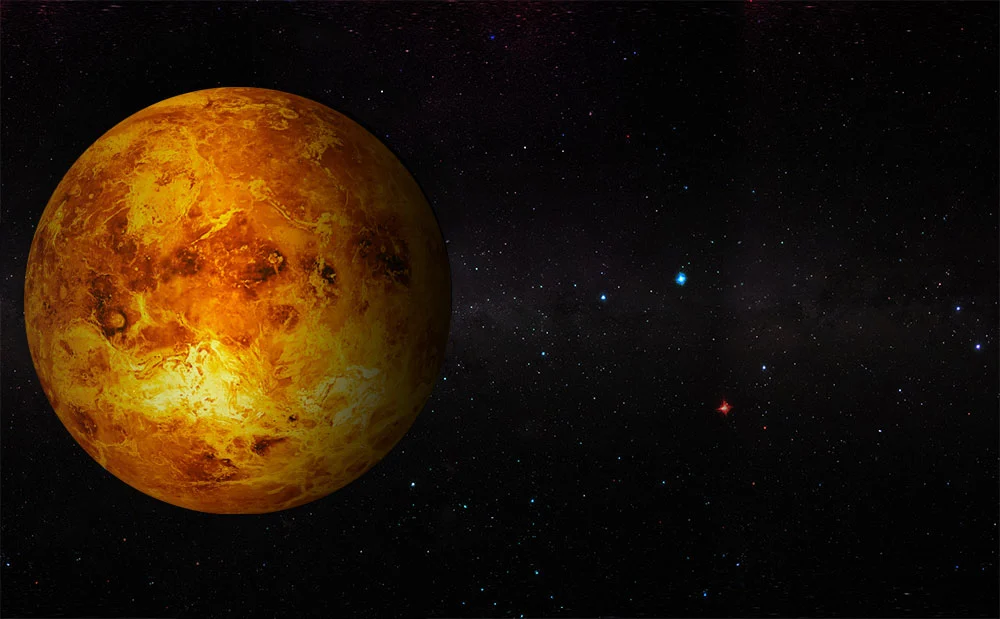
Venus is the second planet from Sol, similar in size to Earth, but with a far hotter and denser surface environment.
♀
Overview / cloud world
Earth’s hostile twin
Venus is often compared with Earth because the two planets are similar in size and structure. But Venus followed a very different path, becoming a world with crushing pressure, intense heat, and a dense atmosphere dominated by carbon dioxide.
Its bright appearance comes from thick cloud cover, but those clouds hide a volcanic surface below. Venus is a key comparison world for understanding rocky planets, atmospheric evolution, and greenhouse heating.
Primary source: NASA Venus facts.
Air / dense atmosphere
Crushing air
Venus has a dense atmosphere made mostly of carbon dioxide.
Pressure, carbon dioxide, and clouds
NASA describes Venus as having a thick atmosphere that traps heat in a runaway greenhouse effect. The atmosphere is mainly carbon dioxide, and the surface pressure is far higher than on Earth.
This atmosphere makes Venus unlike Earth despite their similar sizes. It blocks direct visible views of the surface, drives extreme surface conditions, and keeps the planet hot enough to melt lead.
The atmosphere leads directly into the next section because Venus is the clearest Solar System example of extreme greenhouse heating on a rocky planet.
- Carbon dioxide dominates the air.
- Surface pressure is extremely high.
- Clouds hide the surface below.
Sources: NASA Venus facts; NASA atmosphere et al.
Heat / greenhouse world
Runaway heat
Venus is the hottest planet in the Solar System, even though Mercury is closer to Sol.
Why Venus is hotter than Mercury
Venus is hotter than Mercury because its dense atmosphere traps heat very effectively. NASA describes the result as a runaway greenhouse effect, making Venus the hottest planet in the Solar System.
This makes Venus important for climate comparison. The planet shows how atmospheric composition can dominate surface temperature, even when another planet orbits closer to the Sun.
The greenhouse story also makes Venus a warning case: similar size does not guarantee similar habitability if atmosphere, water, and climate evolve differently.
- Dense air traps infrared heat.
- Venus is hotter than Mercury.
- Atmosphere controls surface conditions.
Sources: NASA Venus facts; NASA climate et al.
Clouds / hidden surface
Acid clouds
Venus is permanently covered by thick clouds made largely of sulphuric acid droplets.
Bright above, hostile below
NASA notes that Venus is cloud-swaddled and highly reflective. Its clouds make it bright in Earth’s sky, but they also prevent ordinary visible-light views of the surface.
The cloud layer contributes to Venus’ distinctive appearance and scientific challenge. Spacecraft have used radar and atmospheric probes to study what lies beneath and within the cloud deck.
Those clouds connect the atmosphere to surface exploration, because understanding Venus requires looking through or descending below the visible cloud cover.
- Clouds make Venus highly reflective.
- Sulphuric acid droplets dominate.
- Radar can reveal the surface.
Sources: NASA Venus clouds; NASA radar et al.
Surface / volcanic planet
Hidden terrain
Below the clouds, Venus has volcanic plains, mountains, impact craters, and deformed terrain.
Radar-mapped geology
Because Venus is hidden under clouds, much of its surface knowledge comes from radar mapping. NASA describes glimpses below the clouds revealing volcanoes and deformed mountains.
The surface appears geologically complex, with broad volcanic plains, highland regions, impact features, and tectonically deformed landscapes. Venus therefore remains important for comparing how rocky planets lose, retain, or renew their surfaces.
The surface story connects to future missions because Venus’ geology is still a major target for planetary science.
- Radar mapping reveals the terrain.
- Volcanic plains cover large areas.
- Deformed mountains record activity.
Sources: NASA Venus facts; NASA VERITAS et al.
Motion / unusual spin
Backwards spin
Venus rotates slowly and in the opposite direction from most planets.
Retrograde rotation
NASA notes that Venus spins slowly in the opposite direction from most planets. This means the Sun would rise in the west and set in the east if seen from the Venusian surface.
Its rotation period is also extremely long compared with its year. Venus takes less time to orbit the Sun than it does to rotate once relative to distant stars.
This unusual spin gives Venus another way to stand apart from Earth despite the two planets being similar in size and inner Solar System location.
- Venus rotates backwards.
- Its day is longer than its year.
- Slow spin shapes the planet’s rhythm.
Sources: NASA Venus facts; NASA planets.
Robots / exploration
Hard target
Venus has been visited by many spacecraft, but its surface is extremely difficult to survive on.
Flybys, orbiters, probes, and landers
NASA states that Mariner 2 became the first spacecraft to visit any planet beyond Earth when it flew past Venus in 1962. Since then, many missions have studied Venus from flyby, orbit, atmosphere, or surface.
The planet is difficult because its surface combines heat, pressure, and corrosive atmospheric chemistry. That makes long-lived surface operations far harder than on Mars or the Moon.
Future missions such as DAVINCI and VERITAS are designed to address major questions about Venus’ atmosphere, history, and geology.
- Mariner 2 first visited Venus.
- Surface survival is difficult.
- New missions target atmosphere and geology.
Sources: NASA Venus exploration; NASA missions et al.
Context / rocky planet comparison
Divergent twin
Venus is similar to Earth in size and structure, but radically different in surface conditions.
Why Venus matters
Venus matters because it helps show that two rocky planets of similar size can follow very different paths. Earth has oceans and a temperate surface; Venus has a dense atmosphere, intense heat, and no confirmed life.
This comparison makes Venus important for climate science, planetary evolution, exoplanet studies, and the search for habitable worlds. Size alone is not enough to determine whether a world remains Earth-like.
For this route, Venus is the warning case before Earth: a nearby rocky planet where atmosphere and climate transformed the surface environment.
- Similar size does not mean similar climate.
- Atmosphere controls planetary outcome.
- Venus is a key exoplanet analogue.
Sources: NASA Venus facts; NASA exoplanets et al.
Evidence / source trail
Sources
Core Venus claims are linked to public science sources used across the dossier.
Venus facts
Planet overview, orbit, rotation, air, and surface.
Venus overview
Cloud world, heat, structure, and science context.
Venus mysteries
Atmosphere, surface pressure, heat, and unknowns.
Temperatures
Venus as the Solar System’s hottest planet.
Exploration
Flybys, orbiters, probes, landers, and missions.
VERITAS
Future mapping of Venus’ surface and geology.
DAVINCI
Atmosphere and descent science mission context.
Venus images
Cloud views, spacecraft images, and visual reference.
© 2026 Phil Forster · Welcome to Sol · Horizontal Solar System briefing