Welcome to Sol
Uranus
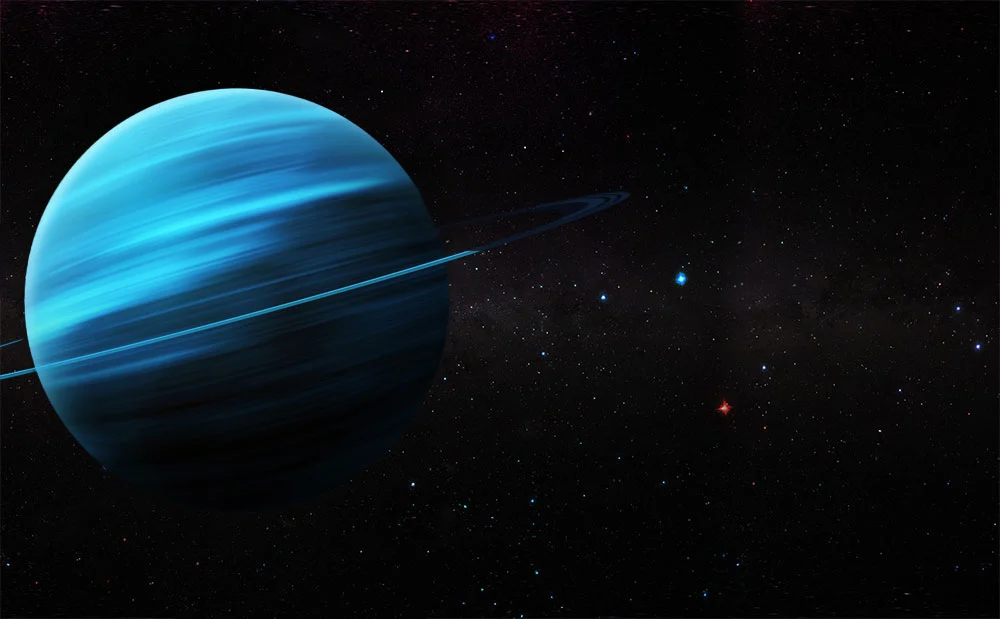
The sideways ice giant: a distant blue-green world with extreme axial tilt, faint rings, cold atmosphere, dark moons, and a magnetic field offset from its centre.
Sideways ice giant
Extreme axial tilt
Faint rings
Briefing / verified snapshot
Uranus file
Uranus is the seventh planet from Sol, an ice giant with a rotation axis tipped almost onto its side.
♅
Overview / sideways ice giant
A tilted outer world
Uranus is an ice giant, different from the rocky inner planets and from the larger gas giants Jupiter and Saturn. Its atmosphere contains hydrogen, helium, and methane, with methane helping give the planet its blue-green colour.
Its defining feature is its extreme axial tilt. Uranus rotates almost on its side, creating seasons unlike those on any other major planet in the Solar System.
Primary source: NASA Uranus facts.
Rotation / axial tilt
Sideways spin
Uranus rotates with its axis tilted almost parallel to its orbital plane.
Extreme seasons on a distant planet
Uranus is famous for its extreme tilt. Instead of rotating upright like many planets, Uranus rolls around the Sun with its poles taking turns facing toward and away from Sol.
This creates unusual seasonal geometry. Each pole can receive long periods of sunlight and darkness as the planet moves through its long 84-year orbit.
The cause of the tilt is still an important question, often linked to a possible ancient impact or interaction during the planet’s early history.
- Uranus rotates almost on its side.
- Its seasons are unusually extreme.
- The tilt may record early Solar System history.
Sources: NASA Uranus facts; NASA Uranus overview.
Atmosphere / methane colour
Blue-green air
Methane in Uranus’ atmosphere absorbs red light and helps create its blue-green appearance.
Cold clouds and subtle weather
Uranus’ upper atmosphere contains methane above deeper hydrogen and helium layers. Methane absorbs red wavelengths of sunlight, leaving the planet with its pale blue-green colour.
The planet can look visually quiet compared with Jupiter or Saturn, but it still has winds, clouds, storms, haze, and seasonal changes.
Because Uranus receives little solar energy, its atmosphere is shaped by cold conditions and by internal planetary processes that are still not fully understood.
- Methane helps create the blue-green colour.
- Clouds and storms can appear.
- Uranus is extremely cold and distant.
Sources: NASA Uranus facts; NASA ice giant overview.
Structure / ice giant
Ice giant
Uranus is classed as an ice giant because its interior differs from the gas giants Jupiter and Saturn.
Water, ammonia, methane, and pressure
The term ice giant does not mean Uranus is simply a frozen ball. It refers to heavier volatile materials in the planet’s interior, including water, ammonia, and methane compounds under extreme pressure.
Uranus and Neptune form a distinct outer-planet category. They are smaller than Jupiter and Saturn, contain proportionally more heavy material, and remain less explored.
Understanding Uranus helps fill the gap between giant planets in our Solar System and the many Neptune-sized worlds found around other stars.
- Uranus is not a rocky planet.
- It differs from Jupiter and Saturn.
- Ice giants are important exoplanet analogues.
Sources: NASA Uranus overview; NASA exoplanet context.
Rings / faint system
Dark rings
Uranus has a faint ring system made of dark, narrow rings.
A subtle ringed planet
Saturn has the most famous rings, but Uranus also has rings. They are much darker and less visually obvious, making them harder to see without specialised observation.
The rings are part of the Uranian system along with its moons. Like other ring systems, they are shaped by gravity, small particles, collisions, and interactions with nearby moons.
The existence of Uranus’ rings helps show that ring systems are common around the giant planets, even when they are not visually dominant.
- Uranus has faint dark rings.
- The rings are much subtler than Saturn’s.
- Moons help shape ring material.
Sources: NASA Uranus facts; NASA ring overview.
Companions / moon system
Icy moons
Uranus has a system of dark, icy moons named largely after literary characters.
Miranda, Ariel, Umbriel, Titania, and Oberon
Uranus’ major moons include Miranda, Ariel, Umbriel, Titania, and Oberon. These worlds are icy, dark, and varied, with surfaces shaped by impacts, fractures, and possible internal activity.
Miranda is especially striking because Voyager 2 images revealed a strange, broken-looking surface with cliffs, ridges, and patchwork terrain.
The moons are scientifically important because they may preserve clues about the formation and long-term evolution of the Uranian system.
- Major moons include Titania and Oberon.
- Miranda has unusual broken terrain.
- The moons are icy and dark.
Sources: NASA Uranus moons; NASA Voyager 2.
Field / offset magnetism
Odd field
Uranus has an unusual magnetic field that is tilted and offset from the planet’s centre.
A lopsided magnetic environment
Uranus’ magnetic field is not neatly aligned with its rotation axis. It is tilted and offset, creating a magnetic environment very different from Earth’s simpler dipole pattern.
Because the planet itself rotates on its side, the magnetic field geometry becomes even stranger as Uranus moves through space and rotates.
This makes Uranus a key target for future study, because its magnetic field may reveal important information about ice giant interiors.
- The magnetic field is tilted.
- The field is offset from the centre.
- Magnetism may reveal interior structure.
Sources: NASA Uranus facts; NASA Voyager 2.
Robots / exploration
Voyager world
Voyager 2 is the only spacecraft to have flown past Uranus.
A brief encounter with a major planet
Most close-up knowledge of Uranus still comes from Voyager 2’s flyby. The spacecraft revealed details of the planet, rings, moons, magnetic field, and atmosphere.
Because there has not yet been an orbiter mission, Uranus remains one of the least explored major planets. Many major questions about its interior, weather, moons, and magnetic field remain open.
That makes Uranus a strong candidate for future outer Solar System exploration, especially because ice giants are common analogues in exoplanet science.
- Voyager 2 flew past Uranus.
- No orbiter has studied it yet.
- Many ice-giant questions remain open.
Sources: NASA Voyager 2; NASA Uranus exploration.
Evidence / source trail
Sources
Core Uranus claims are linked to public science sources used across the dossier.
Uranus overview
Ice giant context, tilt, atmosphere, rings, and moons.
Uranus facts
Distance, size, day, year, atmosphere, and rings.
Uranus moons
Major moons, naming, surfaces, and system context.
Voyager
Outer planet flybys and Uranus encounter history.
Moon imagery
Voyager-era moon views and visual reference.
Uranus images
Planet, ring, and moon visual references.
Planet context
Outer planets and Solar System comparison.
Exoplanet context
Ice giants as useful comparison worlds.
© 2026 Phil Forster · Welcome to Sol · Horizontal Solar System briefing