Welcome to Sol
Sol
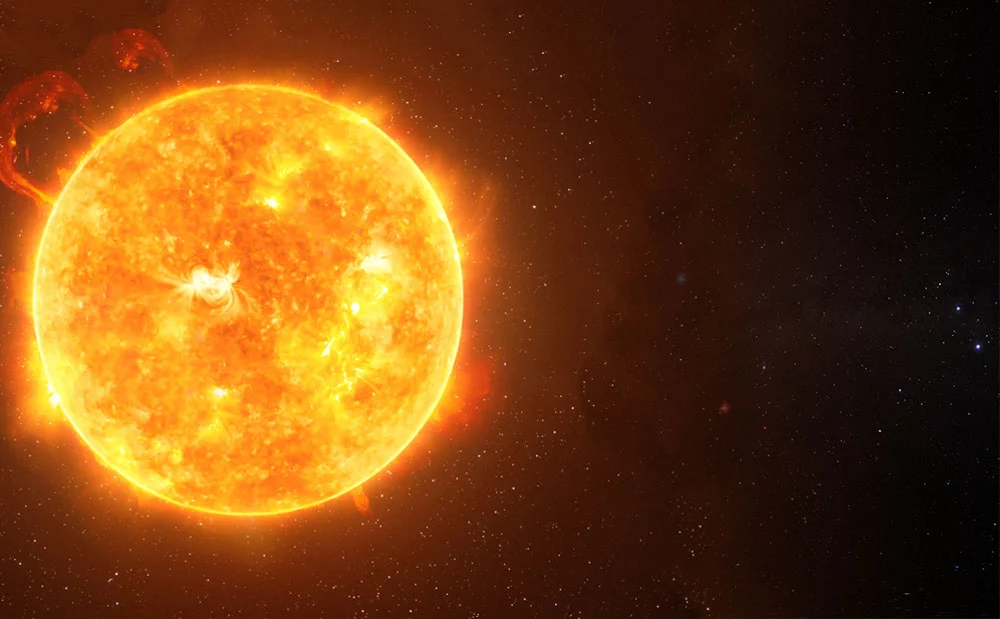
The star at the centre of the Solar System: a vast, active sphere of hot plasma whose gravity, light, heat, and magnetic activity shape every world in the route.
Central star
G-type main sequence
Solar wind
Briefing / verified snapshot
Sol file
Sol is the Solar System’s central star and the gravitational anchor for the planets, dwarf planets, moons, asteroids, and comets.
☉
Overview / central star
A living star
Sol is a G-type main-sequence star. Its gravity holds the Solar System together, while its light and heat drive the surface conditions, climates, and energy balance of the worlds orbiting it.
It is not a static lamp in space. Sol rotates, produces magnetic fields, releases solar wind, generates flares and coronal mass ejections, and follows an activity cycle that changes the space environment around the planets.
Primary source: NASA Sun facts.
Core / energy source
Fusion engine
Sol produces energy in its core through nuclear fusion, converting hydrogen into helium.
Hydrogen, helium, and outward energy
In Sol’s core, extreme temperature and pressure allow hydrogen nuclei to fuse into helium. That process releases energy, which eventually moves outward through the star and escapes into space as sunlight and other radiation.
The energy does not instantly appear at the surface. It moves through internal layers before reaching the photosphere, the visible surface layer from which most sunlight seen by human eyes is emitted.
This fusion process is the reason the rest of the Solar System has a continuing energy source, making Sol the starting point for the whole route.
- Core fusion converts hydrogen into helium.
- Energy travels outward through solar layers.
- Sunlight powers the Solar System environment.
Sources: NASA Sun facts; NASA solar interior et al.
Structure / solar layers
Solar layers
Sol has internal and atmospheric layers, each involved in moving energy and shaping solar activity.
Interior, surface, and atmosphere
Sol is commonly described through layers: core, radiative zone, convective zone, photosphere, chromosphere, transition region, corona, and heliosphere. These are not solid shells, but regions of plasma with different behaviour.
The photosphere is the visible surface layer, while the corona is the outer solar atmosphere. During total solar eclipses, the corona can be seen as a faint extended glow around the obscured Sun.
The layer model matters because different solar features come from different regions, from sunspots and granulation near the visible surface to the corona and solar wind farther out.
- The photosphere is the visible surface layer.
- The corona is the outer solar atmosphere.
- The heliosphere extends solar influence outward.
Sources: NASA Sun layers; NASA heliosphere et al.
Activity / magnetic star
Magnetism
Sol’s magnetic field drives sunspots, flares, coronal mass ejections, and much of solar activity.
Fields, sunspots, and eruptions
Sol is magnetically active. Sunspots are cooler, darker-looking regions linked to strong magnetic fields, while flares are sudden releases of energy from active regions in the solar atmosphere.
Coronal mass ejections can throw large clouds of solar material and magnetic field into space. When directed toward Earth, these events can disturb near-Earth space and contribute to geomagnetic storms.
This magnetic behaviour connects directly to the next section, because solar activity changes over an approximate 11-year cycle.
- Sunspots mark strong magnetic regions.
- Solar flares release sudden energy.
- CMEs can disturb near-Earth space.
Sources: NASA solar activity; NOAA space weather et al.
Rhythm / activity cycle
Solar cycle
Solar activity rises and falls over an approximately 11-year cycle.
Solar minimum to solar maximum
The solar cycle tracks changes in the Sun’s magnetic activity. During solar minimum there are fewer sunspots and active regions; during solar maximum, sunspots, flares, and coronal mass ejections become more common.
The cycle is visible in sunspot counts, but it also matters because increased activity can change the space-weather conditions experienced by spacecraft, astronauts, radio systems, and power infrastructure.
That makes the cycle part of Sol’s wider influence: it is not only the star’s brightness that matters, but also the changing magnetic environment it creates.
- Solar activity follows an approximate cycle.
- Sunspot counts rise and fall.
- Maximum brings more active regions.
Sources: NASA solar cycle; NOAA space weather et al.
Outflow / heliosphere
Solar wind
Sol constantly releases a flow of charged particles into space.
Charged particles through the Solar System
The solar wind is a continuous stream of charged particles flowing outward from the Sun. It carries solar magnetic field material through interplanetary space and shapes the space environment around planets and moons.
Earth’s magnetosphere helps deflect and channel solar-wind particles, producing effects such as aurora. Worlds with weak or absent global magnetic fields interact with the solar wind differently.
This outflow forms part of the heliosphere, the broad region of solar influence through which the planets travel.
- Solar wind carries charged particles outward.
- It shapes planetary space environments.
- The heliosphere marks solar influence.
Sources: NASA solar wind; NASA heliosphere et al.
Context / planetary influence
World shaper
Sol controls the main energy input for the planets and defines the environment through which they orbit.
Light, heat, gravity, and space weather
Sol’s influence is both gravitational and energetic. Its gravity keeps the planets in orbit, while sunlight provides the energy that helps drive surface temperature, weather, photosynthesis on Earth, and climate systems.
Its magnetic activity adds another layer. Flares, coronal mass ejections, and solar wind can affect planetary atmospheres, magnetospheres, spacecraft, and technology near Earth.
For this project, Sol is the baseline source: every planet page that follows describes a world shaped by its distance from, and interaction with, this star.
- Solar gravity anchors planetary orbits.
- Sunlight drives planetary energy balance.
- Space weather links Sol to the planets.
Sources: NASA Sun facts; NOAA space weather et al.
Evidence / source trail
Sources
Core Sol claims are linked to public science sources used across the dossier.
Sun facts
Core overview, size, age, type, and solar role.
Sun overview
Solar science, activity, plasma, and mission context.
Sunspots
Magnetic regions and visible solar activity.
Solar cycle
Activity rhythm, sunspot counts, and solar maximum.
Solar wind
Charged particles and the heliosphere.
Solar flares
Energy releases from active solar regions.
CMEs
Solar eruptions and space-weather context.
Space weather
Operational space-weather monitoring and impacts.
© 2026 Phil Forster · Welcome to Sol · Horizontal Solar System briefing