Welcome to Sol
Saturn
The ringed giant: a hydrogen-helium planet with a vast ring system, fast winds, a complex magnetosphere, and moons that include Titan and Enceladus.
Ringed giant
Titan and Enceladus
Cassini legacy
Briefing / verified snapshot
Saturn file
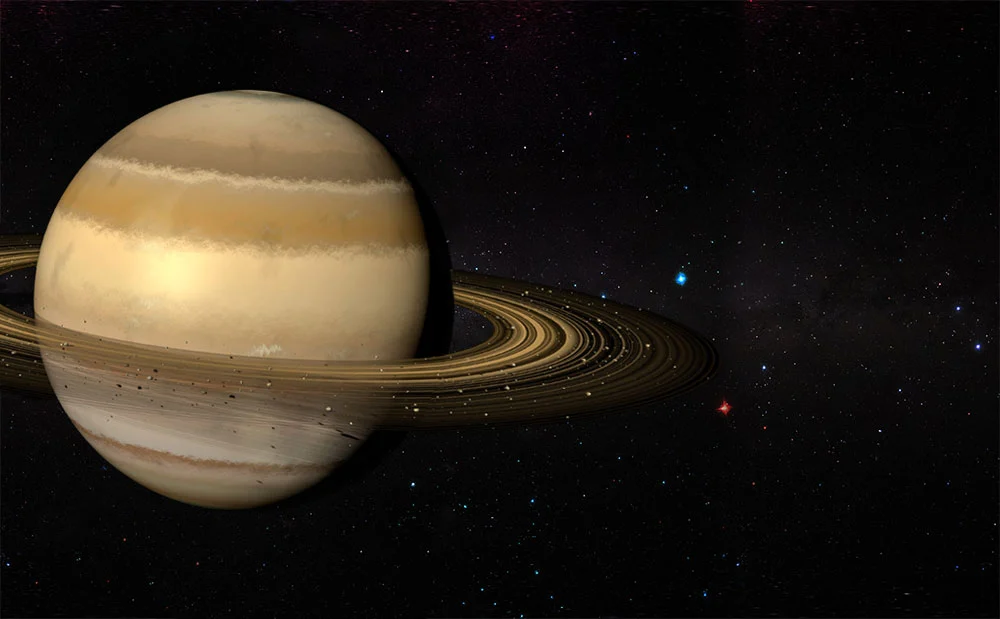
Saturn is the sixth planet from Sol and the second-largest planet in the Solar System.
♄
Overview / ringed giant
A giant with rings
Saturn is a gas giant made mostly of hydrogen and helium. Like Jupiter, it has no solid surface like the terrestrial planets, but its visible atmosphere and rings make it one of the most recognisable worlds in the Solar System.
Its rings are the headline feature, but Saturn is not only a ring display. Its moon system, magnetic environment, storms, and Cassini exploration record make it one of the richest science targets beyond the asteroid belt.
Primary source: NASA Saturn facts.
Rings / ice and rock
Ring system
Saturn’s rings are made from countless particles of ice, rock, and dust.
Billions of particles in orbit
NASA describes Saturn’s rings as pieces of comets, asteroids, or shattered moons, broken apart before reaching the planet. The particles range from dust-sized grains to much larger chunks.
The rings are arranged into complex structures, with gaps, divisions, waves, and interactions with moons. They are broad and spectacular, but also thin compared with their overall width.
Saturn’s rings make the planet visually iconic, yet they are also a live system shaped by gravity, impacts, and moon interactions.
- Rings contain ice, rock, and dust.
- Ring particles vary hugely in size.
- Moons help shape ring structure.
Sources: NASA Saturn facts; NASA Cassini rings.
Atmosphere / gas giant
Pale bands
Saturn’s atmosphere is mostly hydrogen and helium, with cloud bands and fast winds.
Cloud layers and giant-planet weather
Saturn’s visible atmosphere is softer and less contrast-heavy than Jupiter’s, but it is still active. Cloud bands, storms, haze, and high-speed winds shape the planet’s appearance.
Like Jupiter, Saturn rotates quickly for its size. That rapid rotation helps organise atmospheric flow into bands and contributes to the planet’s flattened shape.
The atmosphere connects to the deeper planet, because Saturn’s heat, rotation, composition, and internal structure all help drive its weather systems.
- Hydrogen and helium dominate Saturn.
- Cloud bands wrap around the planet.
- Fast rotation shapes atmospheric flow.
Sources: NASA Saturn overview; NASA Saturn facts.
Structure / low density
Deep planet
Saturn is a giant planet with no solid surface like Earth, Venus, or Mars.
Hydrogen, helium, and pressure
Saturn is made mostly of hydrogen and helium. Moving inward, pressure and temperature rise, changing how material behaves inside the giant planet.
Saturn is famous for being less dense than water on average, although it is not literally a world that could float in any real planetary ocean. The comparison is useful because it shows how different giant planets are from rocky worlds.
Its interior structure matters because it connects Saturn’s atmosphere, gravity field, rings, moons, magnetic environment, and long-term evolution.
- Saturn is mostly hydrogen and helium.
- Pressure rises sharply with depth.
- Its average density is unusually low.
Sources: NASA Saturn facts; NASA Cassini science.
Field / magnetic system
Magnetosphere
Saturn has a magnetic environment shaped by the planet, rings, moons, and charged particles.
Field, plasma, and moon interaction
Saturn’s magnetosphere was studied in detail by Cassini. The system is affected by the planet’s magnetic field, particles from the solar wind, and material supplied by moons and rings.
Enceladus is especially important because its icy plumes contribute material to Saturn’s environment. This means the magnetosphere is linked not only to the planet, but also to its active moon system.
That interaction makes Saturn another example of a planet as a system: atmosphere, rings, moons, and magnetic field all influence one another.
- Cassini measured Saturn’s magnetosphere.
- Moons and rings affect the environment.
- Enceladus supplies material to the system.
Sources: NASA Cassini magnetosphere; NASA Enceladus.
Moon / Titan
Titan
Titan is Saturn’s largest moon and one of the most unusual worlds in the Solar System.
Atmosphere, haze, and surface liquids
Titan has a thick atmosphere and an Earthlike cycle of liquids flowing across its surface. NASA describes it as the only moon with a thick atmosphere.
Instead of surface water rivers and lakes, Titan has surface liquids made of hydrocarbons such as methane and ethane. Its haze hides much of the surface from ordinary visible-light viewing.
Titan matters because it is both familiar and alien: it has weather-like processes, surface liquids, and complex chemistry, but under conditions extremely different from Earth.
- Titan is Saturn’s largest moon.
- It has a thick atmosphere.
- Surface liquids are hydrocarbons.
Sources: NASA Titan; NASA Saturn moons.
Moon / Enceladus
Enceladus
Enceladus is a small icy moon with jets that vent material from an underground ocean.
An icy moon with an ocean
NASA describes Enceladus as a small icy world with geyser-like jets spewing water vapour and ice particles into space. Cassini revealed it as one of the Solar System’s most scientifically important ocean worlds.
The jets supply material to Saturn’s E ring and reveal information about the moon’s subsurface ocean, chemistry, and internal heat.
Enceladus is a leading target in the search for environments where life could exist, though no life has been confirmed there.
- Jets vent water vapour and ice.
- Cassini revealed a global ocean.
- Enceladus supplies Saturn’s E ring.
Sources: NASA Enceladus; NASA Cassini Enceladus.
Robots / exploration
Cassini world
Saturn was transformed from a distant ringed planet into a detailed system by spacecraft exploration.
Flybys, orbiter, and long mission science
Pioneer 11 and the Voyager spacecraft gave early close-up views of Saturn. Cassini then became the defining mission, orbiting Saturn and studying its rings, moons, atmosphere, and magnetic environment for years.
The Cassini-Huygens mission also delivered the Huygens probe to Titan, giving humanity a direct descent through Titan’s atmosphere and images from its surface.
Cassini’s long mission is why Saturn is now understood as a dynamic system rather than a simple planet with rings.
- Pioneer and Voyager made early flybys.
- Cassini orbited Saturn for years.
- Huygens descended through Titan’s air.
Sources: NASA Cassini overview; NASA Titan et al.
Evidence / source trail
Sources
Core Saturn claims are linked to public science sources used across the dossier.
Saturn overview
Ringed giant, composition, scale, and system context.
Saturn facts
Distance, size, day, year, rings, and composition.
Cassini rings
Ring particles, structure, and Enceladus E-ring link.
Saturn moons
Titan, Enceladus, and the wider moon system.
Titan
Atmosphere, liquids, haze, and surface context.
Enceladus
Jets, water vapour, ice particles, and ocean world.
Cassini overview
Orbiter science across Saturn, rings, and moons.
Magnetosphere
Cassini measurements of Saturn’s magnetic system.
© 2026 Phil Forster · Welcome to Sol · Horizontal Solar System briefing