Welcome to Sol
Pluto
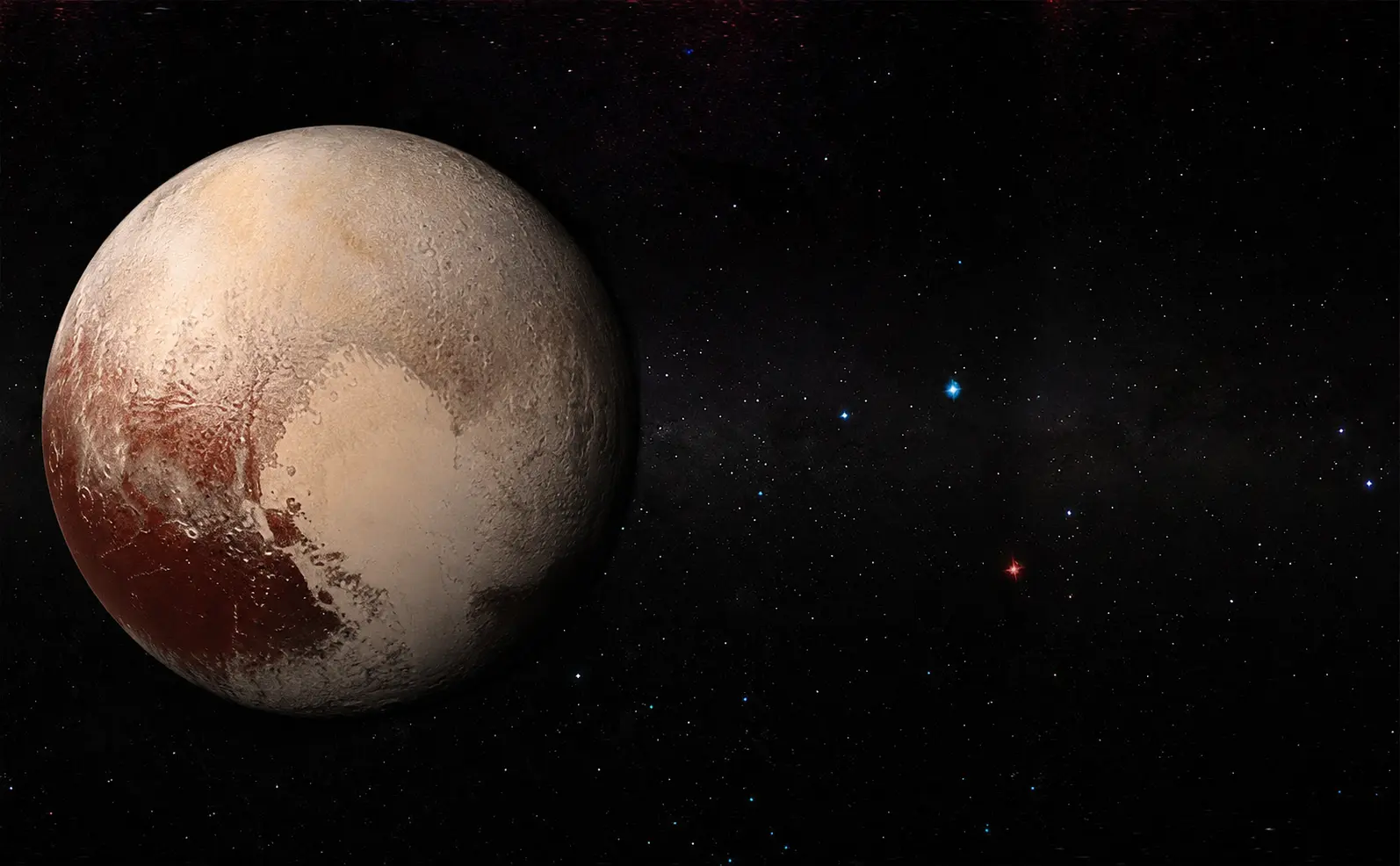
The famous dwarf planet: a small icy world in the Kuiper Belt, with a thin atmosphere, complex geology, a large companion moon, and the heart-shaped Tombaugh Regio.
Kuiper Belt dwarf planet
Former ninth planet
New Horizons flyby
Briefing / verified snapshot
Pluto file
Pluto is a dwarf planet in the Kuiper Belt beyond Neptune, once counted as the ninth planet before reclassification.
♇
Overview / Kuiper Belt world
A small world with a big story
Pluto is a Kuiper Belt dwarf planet beyond Neptune, small but rich in scientific detail. Its icy surface, thin atmosphere, moons, and unusual orbit make it one of the outer Solar System’s most recognisable worlds.
New Horizons revealed mountains, plains, haze, glaciers, and varied colour across Pluto, changing it from a distant point of light into a mapped world with visible landscape and context.
Primary source: NASA Pluto facts.
Status / dwarf planet
Reclassified world
Pluto is now classed as a dwarf planet, not one of the eight major planets, but its scientific value remains central to the outer Solar System story. Its reclassification helps separate major planets from smaller icy worlds while still keeping Pluto as a key object for public interest, planetary science, and Kuiper Belt context.
Planetary, but not a major planet
Pluto was discovered in 1930 and was long treated as the Solar System’s ninth planet. In 2006, the International Astronomical Union reclassified it as a dwarf planet, placing it in a category that better reflects the crowded icy region beyond Neptune.
The reclassification did not make Pluto less interesting. It connected Pluto to a wider family of dwarf planets and Kuiper Belt objects, helping visitors understand that the outer Solar System is not empty space but a varied population of small worlds with different sizes, surfaces, histories, and orbital patterns.
For this route, Pluto works best as a bonus stop after Neptune: not one of the eight major planets, but still a familiar, important, and scientifically rich world with atmosphere, moons, surface features, exploration history, and a clear link to the Kuiper Belt. It gives the route a natural bridge from the recognised planets into the smaller icy bodies beyond them.
- Pluto was discovered in 1930.
- It was reclassified in 2006.
- It remains scientifically important.
Sources: NASA Pluto overview; NASA Kuiper Belt et al.
Region / outer Solar System
Kuiper Belt
Pluto orbits in the Kuiper Belt, a distant region of icy bodies beyond Neptune where small worlds preserve clues about the Solar System’s early structure and outer architecture. This region widens the project beyond the planet list and shows that the Solar System continues into a colder, older population of objects shaped by gravity, resonance, and long-term orbital history.
A frontier of icy leftovers
The Kuiper Belt is a broad region of icy objects beyond Neptune. Pluto is its most famous member and helps represent a wider population of dwarf planets, small bodies, and preserved remnants from Solar System formation. Its position makes Pluto useful as both a named destination and a signpost for the much larger trans-Neptunian region.
This region changes the route from a simple planet list into a wider Solar System story. Beyond Neptune, there are dwarf planets, icy bodies, resonant orbits, and objects that preserve clues from early Solar System history.
Pluto is therefore not an isolated oddity. It is a familiar gateway into the trans-Neptunian region, where the route opens out beyond the major planets into a colder, older, and more scattered outer frontier. That makes the page less about demotion and more about showing how the Solar System is organised beyond Neptune.
- The Kuiper Belt lies beyond Neptune.
- It contains many icy objects.
- Pluto is its best-known member.
Sources: NASA Kuiper Belt; NASA Pluto overview.
Surface / varied terrain
Icy geology
Pluto has mountains, plains, craters, glaciers, and varied icy terrain, giving this small distant world a surprisingly complex surface record shaped by impacts, volatile ices, and changing conditions. New Horizons showed that Pluto is not visually simple: its terrain includes bright regions, darker areas, smooth plains, rugged landscapes, and features that suggest movement and surface renewal.
Mountains, plains, and bright ice
New Horizons revealed Pluto as a geologically complex world. Its surface includes mountains made of water ice, plains of nitrogen ice, cratered terrain, bright regions, and features shaped by volatile ices moving across the landscape. Tombaugh Regio and Sputnik Planitia give visitors recognisable anchors while also showing how active-looking Pluto became once seen up close.
The most famous feature is Tombaugh Regio, the bright heart-shaped region visible in New Horizons imagery. Part of it includes Sputnik Planitia, a broad plain of nitrogen ice.
That surface variety surprised many people because Pluto had often been imagined as a simple frozen remnant, rather than a world with visible terrain, contrast, texture, and active-looking geology still worth close study. The surface card should therefore read as a proper landscape briefing, not just a short note about ice and craters.
- Pluto has water-ice mountains.
- Sputnik Planitia is nitrogen-rich terrain.
- Tombaugh Regio forms the famous heart.
Sources: NASA Pluto facts; NASA New Horizons et al.
Air / thin atmosphere
Hazy air
Pluto has a very thin atmosphere that changes as it moves around Sol, linking the dwarf planet’s surface ice, seasons, distant sunlight, and long orbital cycle. It is not Earth-like air, but it still gives Pluto structure above the surface and connects the page to weather, chemistry, and seasonal change.
A fragile atmosphere far from Sol
Pluto’s atmosphere is slight, cold, and mainly nitrogen, with methane and carbon monoxide also present. It is a fragile outer layer shaped by distance, temperature, sunlight, and frozen surface material. New Horizons showed haze layers, proving that even a small distant dwarf planet can have visible atmospheric structure and chemistry.
New Horizons observed haze around Pluto, showing that even a small distant dwarf planet can have atmospheric structure. Those layers help connect surface ice, sunlight, and seasonal change.
Because Pluto follows an elliptical orbit, scientists track how its atmosphere responds as the world moves nearer to and farther from Sol across its long year, revealing how small icy bodies react to changing light. That makes Pluto a useful case study for atmosphere-surface interaction at the edge of the planetary route.
- Nitrogen dominates Pluto’s atmosphere.
- New Horizons observed atmospheric haze.
- The atmosphere may vary with orbit.
Sources: NASA Pluto facts; NASA New Horizons.
Companion / Charon
Charon
Charon is Pluto’s largest moon and gives the system a paired-world character, making the dwarf planet feel less isolated than its distance suggests and more like the centre of a compact local system. Because Charon is unusually large compared with Pluto, the pair reads differently from a normal planet-and-moon example.
A double-world feeling
Charon is unusually large compared with Pluto, giving the pair a double-world feel rather than a simple planet-and-moon pattern. They orbit a shared centre of mass outside Pluto itself, which makes their motion especially distinctive. This helps explain why the Pluto system is scientifically interesting beyond Pluto alone.
New Horizons showed Charon as a varied world with canyons, broad plains, darker polar material, and signs of past geological change across its surface, adding depth to the wider Pluto system. Nix, Hydra, Styx, and Kerberos complete the compact moon family and make the card feel like a system briefing rather than a single-object note.
Pluto also has four smaller moons: Nix, Hydra, Styx, and Kerberos. Together with Charon, they make Pluto a compact but complex system rather than an isolated dwarf planet.
- Charon is Pluto’s largest moon.
- Pluto and Charon form a paired system.
- Four smaller moons complete the system.
Sources: NASA Pluto moons; NASA New Horizons.
Robots / exploration
New Horizons
New Horizons gave Pluto and Charon their first close-up exploration record, turning distant outer Solar System objects into mapped worlds with visible detail, measured structure, and recognisable surface character. The mission changed Pluto from a famous name into a photographed landscape with mountains, plains, haze, glaciers, colour, and context.
The 2015 flyby
NASA’s New Horizons spacecraft flew past Pluto in July 2015, giving humanity its first close-up view of Pluto, Charon, and the wider system after decades of distant observation from Earth and space telescopes. The flyby also connected Pluto to the Kuiper Belt because the spacecraft continued outward after the encounter.
The flyby revealed mountains, glaciers, smooth plains, atmospheric haze, and complex colour patterns, making Pluto feel like a real place rather than a remote catalogue entry.
After Pluto, New Horizons continued into the Kuiper Belt, linking the flyby to a wider exploration story beyond the major planets and deeper into the outer Solar System’s population of icy bodies. For the route, that makes New Horizons the bridge between a familiar dwarf planet and the much larger region beyond Neptune.
- New Horizons flew past Pluto in 2015.
- It mapped Pluto and Charon in detail.
- The mission continued into the Kuiper Belt.
Sources: NASA New Horizons; NASA Pluto overview.
Evidence / source trail
Sources
Core Pluto claims are linked to public science sources used across the dossier, keeping the route readable while preserving a visible evidence trail. NASA supports the main physical facts, moons, and New Horizons mission record. The IAU covers classification, USGS supports mapping context, The Planetary Society gives accessible mission and Kuiper Belt background, and Britannica provides an independent reference check.
Pluto overview
Broad public overview linking Pluto’s orbit, surface, atmosphere, moons, and Kuiper Belt setting.
Pluto facts
Reference figures for Pluto’s size, distance, day, year, atmosphere, and orbital behaviour.
Pluto moons
Guide to Charon and the smaller moons that make Pluto a compact system.
New Horizons
Mission page for the spacecraft that turned Pluto into a mapped, textured world.
IAU classification
Primary classification context for Pluto’s dwarf-planet status and wider naming rules.
Pluto mapping
Geologic mapping reference for named terrain, elevations, and New Horizons surface interpretation.
Planetary Society
Human-readable mission context connecting Pluto, Charon, and Kuiper Belt exploration.
Pluto reference
Independent reference summary covering Pluto’s discovery, characteristics, moons, and scientific status.
© 2026 Phil Forster · Welcome to Sol · Horizontal Solar System briefing