Welcome to Sol
Neptune
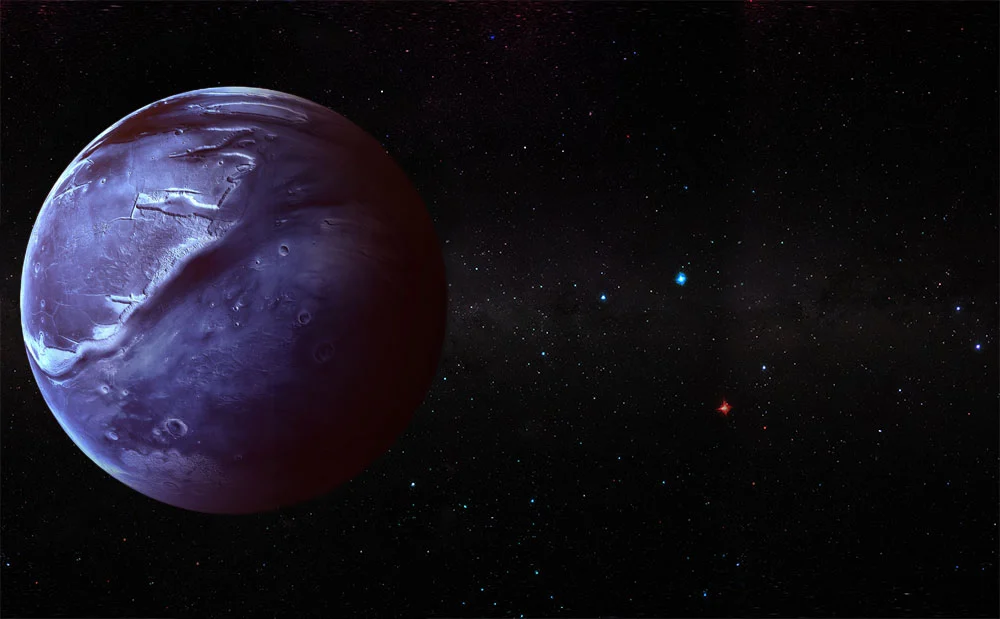
The outer ice giant: a deep-blue world with fierce winds, dark storm systems, faint rings, distant sunlight, and Triton, a captured moon with active geology.
Outermost planet
Fast winds and storms
Triton system
Briefing / verified snapshot
Neptune file
Neptune is the eighth major planet from Sol and the most distant recognised planet in the Solar System.
♆
Overview / outer ice giant
A distant blue world
Neptune is an ice giant, similar in broad category to Uranus but with a deeper blue appearance and more visibly active weather. Methane in the atmosphere helps shape the colour, while clouds and storms reveal a dynamic outer atmosphere.
It receives far less sunlight than the inner planets, yet Neptune still has powerful winds and changing storm systems. That makes it a key world for understanding how giant-planet atmospheres work far from the Sun.
Primary source: NASA Neptune facts.
Atmosphere / blue giant
Methane air
Neptune’s atmosphere contains hydrogen, helium, and methane.
Colour, clouds, and cold
Methane in Neptune’s upper atmosphere absorbs red light and helps give the planet its blue appearance. The planet is extremely cold and distant, but its atmosphere remains active.
Neptune’s visible features include clouds, hazes, and storm systems. Bright cloud streaks can appear at high altitude, while darker storm regions can form and change over time.
The atmosphere makes Neptune more visually dramatic than its distance might suggest, because even at the edge of the planetary route it is not a static or frozen-looking world.
- Methane helps create the blue colour.
- Clouds and hazes appear in the atmosphere.
- Storm systems can form and change.
Sources: NASA Neptune facts; NASA Neptune overview.
Weather / fierce winds
Fastest winds
Neptune is known for extremely fast winds and powerful atmospheric motion.
Weather far from the Sun
Despite being far from Sol, Neptune has some of the fastest winds measured in the Solar System. Its atmosphere can support powerful jet streams, bright clouds, and large storm systems.
This is one of Neptune’s central puzzles. With weak sunlight at such distance, scientists study how internal heat, atmospheric structure, and rotation help drive the planet’s weather.
The result is an outer planet that looks calm from a distance but is meteorologically intense when studied in detail.
- Neptune has extremely fast winds.
- Storms can appear and fade.
- Internal heat may help drive weather.
Sources: NASA Neptune facts; NASA Hubble storm studies.
Storms / dark spots
Dark storms
Neptune has produced dark storm systems observed by spacecraft and telescopes.
Great Dark Spot and changing weather
Voyager 2 observed a large dark storm on Neptune during its 1989 flyby. Later observations showed that dark storms on Neptune can appear, move, change, and disappear.
These storm systems are often accompanied by bright clouds, giving scientists a way to study vertical motion, atmospheric chemistry, and wind patterns.
Neptune’s storms make it a strong comparison with Jupiter and Saturn: all three giants have dramatic weather, but each planet runs that weather under different conditions.
- Voyager 2 observed a Great Dark Spot.
- Dark storms can change over time.
- Bright clouds often accompany storms.
Sources: NASA Voyager 2; NASA Neptune storm studies.
Structure / ice giant
Ice giant
Neptune is an ice giant, not a rocky planet and not a Jupiter-like gas giant.
Heavy volatiles under pressure
Like Uranus, Neptune is called an ice giant because its interior contains heavier volatile materials such as water, ammonia, and methane under extreme pressure.
The term does not mean the planet is simply made of ordinary ice. At Neptune’s pressures and temperatures, materials behave very differently from their familiar surface forms on Earth.
Studying Neptune helps scientists understand a category of planet that appears common around other stars, making it important beyond this Solar System alone.
- Neptune is an ice giant.
- Its interior differs from Jupiter’s.
- Ice giants are useful exoplanet analogues.
Sources: NASA Neptune overview; NASA exoplanet context.
Rings / faint arcs
Faint rings
Neptune has a faint ring system, including clumpy ring arcs.
Dusty rings at the edge
Neptune’s rings are faint and dark, much less obvious than Saturn’s. They include narrow ring features and arcs, making the system visually subtle but scientifically important.
The rings are likely shaped by gravity, small moons, impacts, and dust-sized material. As with Uranus and Jupiter, they show that ring systems are not unique to Saturn.
Neptune’s ring system completes the outer giant-planet pattern: every giant planet has rings, but each ring system looks and behaves differently.
- Neptune has faint rings.
- Some ring material forms arcs.
- Small moons help shape the system.
Sources: NASA Neptune facts; NASA ring overview.
Moon / Triton
Triton
Triton is Neptune’s largest moon and one of the Solar System’s most unusual captured worlds.
A captured moon with active geology
Triton orbits Neptune in a retrograde direction, opposite the planet’s rotation, which strongly suggests it was captured rather than forming in place with Neptune.
Voyager 2 observed Triton and revealed a surprisingly active icy world, including geyser-like plumes and varied terrain.
Triton is scientifically important because it may be related to Kuiper Belt objects, giving Neptune a direct connection to the icy outer Solar System.
- Triton orbits in retrograde motion.
- Voyager 2 observed active plumes.
- Triton may be a captured Kuiper Belt body.
Sources: NASA Triton; NASA Voyager 2.
Robots / exploration
Voyager world
Voyager 2 is the only spacecraft to have visited Neptune.
One flyby, many questions
Voyager 2 flew past Neptune in 1989, providing the only close spacecraft encounter with the planet. That flyby revealed Neptune’s winds, storms, rings, moons, and Triton in new detail.
No orbiter has studied Neptune yet, so many questions remain about its interior, atmosphere, magnetic field, ring arcs, and moon system.
As the final planet on the route, Neptune marks both an endpoint and an unfinished frontier for planetary exploration.
- Voyager 2 made the only Neptune flyby.
- No Neptune orbiter has flown yet.
- Many ice-giant questions remain open.
Sources: NASA Voyager 2; NASA Neptune exploration.
Evidence / source trail
Sources
Core Neptune claims are linked to public science sources used across the dossier.
Neptune overview
Ice giant context, atmosphere, rings, moons, and storms.
Neptune facts
Distance, size, day, year, atmosphere, and rings.
Triton
Retrograde orbit, capture context, and active geology.
Voyager
Outer planet flybys and Neptune encounter history.
Neptune images
Planet, clouds, rings, and moon visual references.
Planet context
Outer planets and Solar System comparison.
Exoplanet context
Ice giants as comparison worlds around other stars.
Kuiper Belt
Outer Solar System context for Triton-like bodies.
© 2026 Phil Forster · Welcome to Sol · Horizontal Solar System briefing