Welcome to Sol
Mercury
The innermost planet: a small rocky world of extreme temperature swings, ancient craters, a thin exosphere, no moons, and a surface shaped by impacts and solar exposure.
Innermost planet
Fastest orbit
Extreme temperatures
Briefing / verified snapshot
Mercury file
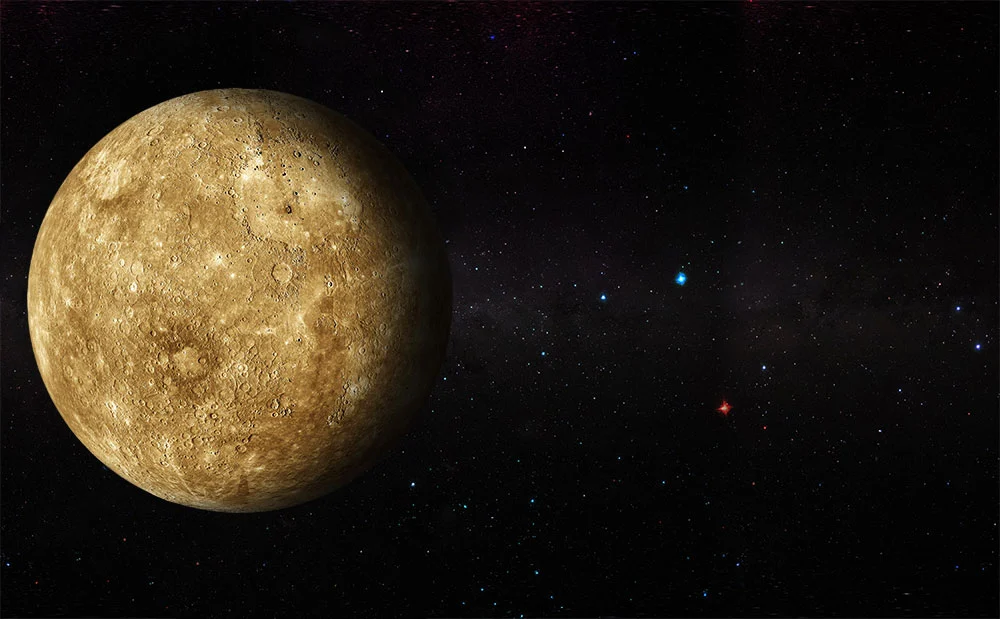
Mercury is the closest planet to Sol, the smallest planet in the Solar System, and a heavily cratered terrestrial world.
☿
Overview / innermost planet
A scorched rocky world
Mercury is the smallest planet and the closest planet to Sol. Its surface is heavily cratered, and its proximity to the Sun exposes it to intense solar radiation and extreme temperature contrasts.
Despite being nearest to the Sun, Mercury is not the hottest planet; Venus is hotter because of its dense greenhouse atmosphere. Mercury instead stands out as a bare, rocky world with almost no atmosphere to trap heat.
Primary source: NASA Mercury facts.
Orbit / fast inner world
Swift orbit
Mercury completes an orbit around Sol in only 88 Earth days.
Shortest year in the Solar System
Mercury moves around the Sun faster than any other planet. Its year is only 88 Earth days, making it the fastest-orbiting planet in the Solar System.
Its rotation is much slower than its orbit. NASA lists one Mercury day as 1,408 hours, so the relationship between sunrise, sunset, and orbital motion is very different from Earth.
This unusual rhythm helps explain why Mercury is not simply “hot all the time”; location, sunlight, shadow, and rotation all matter.
- Fastest planetary orbit.
- One year lasts 88 Earth days.
- Rotation is slow compared with orbit.
Sources: NASA Mercury facts; NASA planets.
Environment / extremes
Heat and cold
Mercury experiences some of the Solar System’s most extreme surface temperature changes.
Solar glare without a blanket
Mercury is close to Sol, so its sunlit surface can become extremely hot. At the same time, it has no substantial atmosphere to spread and retain heat the way Earth or Venus can.
That means shadowed and night-side regions can become extremely cold. The planet’s environment is therefore defined by contrast rather than a single simple temperature.
This temperature behaviour links directly to Mercury’s exosphere: there is too little gas around the planet to act like a protective or heat-distributing atmosphere.
- Dayside regions can become extremely hot.
- Night-side regions can become very cold.
- No thick atmosphere moderates heat.
Sources: NASA Mercury facts; NASA solar system.
Air / thin boundary
Exosphere
Mercury has a thin exosphere rather than a dense, weather-producing atmosphere.
Atoms knocked from the surface
NASA describes Mercury as having a thin exosphere made of atoms blasted from the surface by the solar wind and by micrometeoroid impacts. This is very different from Earth’s dense atmosphere.
Because the exosphere is so thin, it cannot support weather, clouds, pressure systems, or meaningful heat transport. Mercury’s surface is directly exposed to space conditions.
The exosphere helps connect Mercury’s surface to the space environment: the planet is shaped not only from below by geology, but from above by solar wind and impacts.
- Mercury has a thin exosphere.
- Solar wind affects surface material.
- No weather system operates there.
Sources: NASA Mercury facts; NASA MESSENGER et al.
Surface / ancient terrain
Cratered world
Mercury’s surface preserves craters, plains, cliffs, and impact features from a long geological record.
Impacts, plains, and scarps
Mercury’s surface is heavily cratered, resembling the Moon in many ways, but it also has distinctive cliffs called scarps. These features are linked to the planet’s long-term cooling and contraction.
Large impact basins, volcanic plains, crater rays, and fractured terrain give Mercury a complex surface history. Spacecraft images have shown that the planet is not simply an inert grey rock.
Surface geology matters because it gives scientists a record of impact history, volcanic activity, planetary cooling, and the conditions affecting small rocky worlds near a star.
- Impact craters cover much of the surface.
- Scarps record planetary contraction.
- Plains and basins preserve history.
Sources: NASA Mercury facts; NASA MESSENGER.
Interior / magnetic field
Magnetic field
Mercury has a global magnetic field, unusual for such a small rocky planet.
A small world with an active interior
Mercury has a magnetic field, which indicates important information about its interior. NASA’s MESSENGER mission measured Mercury’s magnetic and surface properties from orbit.
The planet also has a large metallic core relative to its size. That makes Mercury especially useful for studying how small rocky planets form, cool, and retain internal activity.
The magnetic field links Mercury to Sol because the planet sits deep inside the solar wind environment, where magnetic and charged-particle interactions are intense.
- Mercury has a global magnetic field.
- MESSENGER studied it from orbit.
- The large core is scientifically important.
Sources: NASA MESSENGER; NASA Mercury facts.
Poles / permanent shadow
Polar ice
Mercury can preserve water ice in permanently shadowed polar craters.
Ice on the closest planet
Mercury seems like an unlikely place for ice because it orbits so close to Sol. But permanently shadowed crater floors near the poles can remain cold enough to preserve volatile material.
NASA has reported evidence for water ice in Mercury’s polar regions. This shows how local geography can create protected environments even on a planet exposed to intense sunlight.
That makes Mercury a useful reminder that planetary conditions are not always uniform: shadow, topography, rotation, and sunlight angle can create very different environments on the same world.
- Polar craters can stay shadowed.
- Water ice evidence exists there.
- Local conditions shape environments.
Sources: NASA Mercury facts; NASA MESSENGER et al.
Robots / exploration
Visited world
Mercury has been explored by Mariner 10 and MESSENGER, with BepiColombo travelling there.
Hard to reach, hard to study
Mercury is difficult to observe and difficult to visit because it sits close to the Sun from Earth’s point of view. NASA’s Mariner 10 was the first spacecraft to visit Mercury, using Venus for a gravity assist.
MESSENGER later became the first spacecraft to orbit Mercury, mapping the planet and measuring its surface, exosphere, magnetic field, and interior clues.
ESA and JAXA’s BepiColombo mission continues the exploration story, making Mercury a small planet with a long scientific return.
- Mariner 10 first visited Mercury.
- MESSENGER first orbited Mercury.
- BepiColombo continues exploration.
Sources: NASA Mercury exploration; NASA MESSENGER et al.
Evidence / source trail
Sources
Core Mercury claims are linked to public science sources used across the dossier.
Mercury facts
Planet overview, day, year, distance, and surface.
Mercury overview
Smallest planet, innermost orbit, and core context.
MESSENGER
Orbital mapping, surface composition, and field data.
Mariner 10
First spacecraft to visit Mercury.
Mercury images
Spacecraft views of craters, plains, and terrain.
Exploration
Mercury missions and observing challenges.
BepiColombo
ESA/JAXA mission continuing Mercury science.
Planet context
Inner planets and Solar System comparison.
© 2026 Phil Forster · Welcome to Sol · Horizontal Solar System briefing