Welcome to Sol
Mars
The red planet: a cold rocky world with a thin atmosphere, ancient water evidence, giant volcanoes, deep canyons, two moons, and the most explored surface beyond Earth.
Red planet
Ancient water evidence
Robotic exploration
Briefing / verified snapshot
Mars file
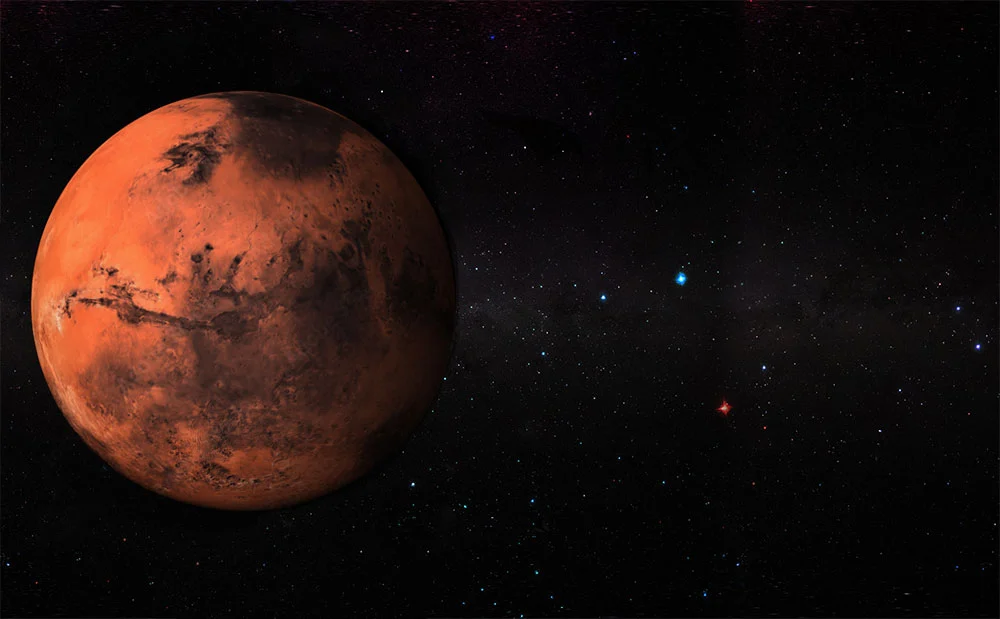
Mars is the fourth planet from Sol, a cold terrestrial world with a thin carbon dioxide atmosphere and two small moons.
♂
Overview / red planet
A cold rocky world
Mars is a rocky planet with a dry, dusty surface and a thin atmosphere dominated by carbon dioxide. Its red colour comes from iron-rich minerals in surface dust and rock.
The planet is cold and harsh today, but its surface preserves channels, minerals, deltas, and layered rocks that point to a wetter ancient history.
Primary source: NASA Mars facts.
History / ancient water
Water record
Mars is dry today, but its surface preserves evidence that liquid water once shaped parts of the planet.
Channels, minerals, and ancient environments
Mars has ancient river valleys, lakebeds, deltas, and minerals linked to water. These features suggest early Mars had conditions very different from the cold, dry surface seen today.
Rovers and orbiters study sedimentary rocks, hydrated minerals, crater deposits, and ancient terrain to reconstruct that environmental history.
This water record does not prove life existed, but it makes Mars central to questions about past habitability.
- Ancient valleys and lakebeds are preserved.
- Some minerals formed with water present.
- Water evidence guides habitability studies.
Sources: NASA Mars facts; NASA Mars water et al.
Air / thin atmosphere
Thin air
Mars has a thin atmosphere dominated by carbon dioxide, with surface pressure far lower than Earth’s.
Cold surface, dust, and atmospheric loss
The modern Martian atmosphere is too thin to support Earth-like surface conditions. It offers limited shielding, holds little heat, and allows large temperature swings.
Dust is an important part of the Martian environment. Local, regional, and global dust storms can affect sunlight, temperature, and spacecraft operations.
Atmospheric loss is also part of Mars’ long-term story, helping explain how the planet changed from its wetter past to its present state.
- Carbon dioxide dominates the atmosphere.
- Thin air limits heat retention.
- Dust storms affect surface conditions.
Sources: NASA Mars facts; NASA MAVEN et al.
Surface / volcanoes and canyons
Giant terrain
Mars has some of the Solar System’s most dramatic surface features, including vast volcanoes and canyon systems.
Olympus Mons and Valles Marineris
Mars is home to Olympus Mons, a giant shield volcano, and Valles Marineris, an enormous canyon system. These features show that Mars has experienced major geological activity.
The surface also carries impact craters, lava plains, polar deposits, dunes, dust-covered rock, and layered sedimentary terrain.
That surface record gives scientists a readable history of impacts, volcanism, water, climate, and planetary change.
- Olympus Mons is a giant shield volcano.
- Valles Marineris is a vast canyon system.
- Layered rocks preserve environmental history.
Sources: NASA Mars facts; NASA Mars surface et al.
Companions / small moons
Two moons
Mars has two small moons: Phobos and Deimos.
Phobos and Deimos
Phobos is the larger and closer Martian moon, while Deimos is smaller and more distant. Both are small, irregular worlds rather than large round moons like Earth’s Luna.
Phobos orbits very close to Mars and is slowly moving inward. Deimos orbits farther out and takes longer to circle the planet.
Their origin remains scientifically important because it connects Mars to small bodies, impacts, and early Solar System history.
- Phobos is larger and closer.
- Deimos is smaller and more distant.
- Both moons are small and irregular.
Sources: NASA Mars moons; NASA Phobos et al.
Robots / exploration
Explored world
Mars is the most heavily explored planetary surface beyond Earth.
Orbiters, landers, and rovers
Mars has been studied by flybys, orbiters, landers, and rovers. Surface missions have examined rocks, soils, weather, radiation, ancient water environments, and landing-site geology.
Rover missions such as Spirit, Opportunity, Curiosity, and Perseverance have helped build the modern view of Mars as a changing world with a complex past.
That exploration record makes Mars the practical bridge between planetary science and future human exploration planning.
- Rovers study rocks directly on the surface.
- Orbiters map terrain, minerals, and weather.
- Mars guides future human mission planning.
Sources: NASA Mars exploration; NASA rovers et al.
Context / habitability
Past potential
Mars is not known to host life, but it is a key world for studying past habitability.
Why Mars matters
Mars matters because it preserves evidence of ancient environments that may once have been more favourable than today. Its rocks can hold clues about water, chemistry, climate, volcanic activity, and atmospheric loss.
That makes Mars different from Earth, but also deeply connected to it as a comparison case. Earth shows confirmed habitability; Mars shows how a rocky planet can change over time.
For this route, Mars is the first world beyond Earth where the question of ancient habitable environments becomes central.
- No confirmed Martian life is known.
- Ancient water evidence drives investigation.
- Mars is a key astrobiology target.
Sources: NASA Mars facts; NASA astrobiology et al.
Evidence / source trail
Sources
Core Mars claims are linked to public science sources used across the dossier.
Mars facts
Planet overview, day, year, air, moons, and surface.
Mars overview
Mission context and red planet science background.
Martian moons
Phobos, Deimos, moon distances, and orbital behaviour.
Exploration rovers
Spirit and Opportunity surface science legacy.
Exploration
Orbiters, landers, rovers, and mission history.
Curiosity
Rover science and ancient environment context.
Perseverance
Astrobiology, sampling, and Jezero crater context.
MAVEN
Atmosphere loss and solar-wind interaction.
© 2026 Phil Forster · Welcome to Sol · Horizontal Solar System briefing