Welcome to Sol
Jupiter
The giant planet: a vast gas world with banded clouds, deep storms, a powerful magnetic environment, faint rings, and a moon system that works like a miniature planetary system.
Largest planet
Great Red Spot
Galilean moons
Briefing / verified snapshot
Jupiter file
Jupiter is the fifth planet from Sol and the largest planet in the Solar System.
♃
Overview / king of planets
A giant weather world
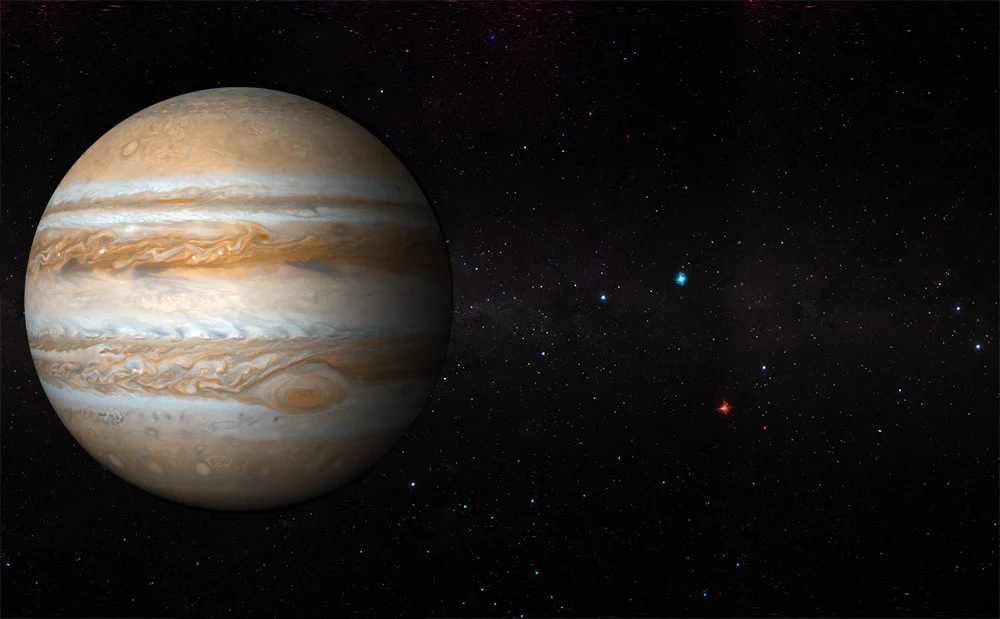
Jupiter is a gas giant made mostly of hydrogen and helium. It has no solid surface like Earth or Mars, and its visible face is made of cloud bands, storms, and atmospheric circulation.
Its scale dominates the planetary route. Jupiter is massive enough to shape the architecture of the Solar System, influence smaller bodies, and hold a moon system with worlds of major scientific interest.
Primary source: NASA Jupiter facts.
Atmosphere / cloud bands
Banded planet
Jupiter’s visible surface is a layered atmosphere of clouds, belts, zones, and fast-moving winds.
Belts, zones, and fast rotation
Jupiter’s striped appearance comes from atmospheric bands moving at different speeds and directions. These belts and zones give the planet its distinctive cream, tan, orange, and brown pattern.
The planet rotates very quickly for its size. That fast spin helps stretch cloud systems into long bands and contributes to the dynamic weather patterns seen across the globe.
Jupiter’s atmosphere is not a decorative surface; it is the outer visible layer of a vast planet with deep internal structure and powerful circulation.
- Cloud bands form belts and zones.
- Fast rotation shapes atmospheric flow.
- The visible surface is not solid ground.
Sources: NASA Jupiter facts; NASA Jupiter overview.
Weather / giant storms
Great Red Spot
Jupiter’s Great Red Spot is a long-lived storm system larger than Earth.
A storm with deep roots
The Great Red Spot is Jupiter’s most famous feature. NASA describes it as a huge oval storm that has been observed for centuries, with Juno findings showing that some Jovian storms extend far below the cloud tops.
Jupiter also has many smaller storms, turbulent boundaries, polar cyclones, and changing cloud structures. Its atmosphere is therefore a live laboratory for large-scale fluid motion.
The storm systems are part of why Jupiter feels visually alive: the planet’s appearance changes as clouds shear, fold, merge, and rotate.
- The Great Red Spot is a major storm.
- Juno has probed storm depth.
- Jupiter’s weather changes over time.
Sources: NASA Great Red Spot; NASA Juno et al.
Structure / gas giant
Deep planet
Jupiter is a gas giant without a solid surface like the terrestrial planets.
Hydrogen, helium, and pressure
Jupiter is composed mostly of hydrogen and helium. Moving inward, pressure and temperature increase dramatically, changing how material behaves deep inside the planet.
Scientists study Jupiter’s interior to understand planet formation, giant-planet structure, and the early Solar System. NASA’s Juno mission was designed to investigate the planet’s gravity field, magnetic field, atmosphere, and deep structure.
Jupiter’s interior links atmosphere and magnetosphere together, because the planet’s size, spin, and internal dynamics help power its wider environment.
- Hydrogen and helium dominate Jupiter.
- Pressure rises sharply with depth.
- Juno studies the planet’s deep structure.
Sources: NASA Jupiter facts; NASA Juno mission.
Field / magnetic giant
Magnetosphere
Jupiter has a powerful magnetic environment shaped by its size, rotation, and moon system.
Radiation, aurora, and moon interaction
Jupiter’s magnetosphere is one of its defining features. The planet’s magnetic environment traps charged particles and creates intense radiation regions around the planet.
The volcanic moon Io supplies material to Jupiter’s magnetic environment, while other moons interact with the field in different ways. These connections make Jupiter a planet-moon system, not just a single body.
The magnetic environment also creates aurora near Jupiter’s poles, linking the planet’s atmosphere, rotation, field, and moons into one dynamic system.
- Jupiter has a powerful magnetic field.
- Radiation belts surround the planet.
- Moons interact with the magnetosphere.
Sources: NASA Jupiter overview; NASA Juno et al.
Companions / moon system
Galilean moons
Jupiter’s four largest moons are Io, Europa, Ganymede, and Callisto.
A miniature system of worlds
The Galilean moons are among the most important moons in the Solar System. Io is volcanically active, Europa is strongly associated with subsurface-ocean studies, Ganymede is the largest moon in the Solar System, and Callisto preserves an ancient cratered surface.
These moons are large enough and varied enough to make Jupiter feel like a small system of worlds. They help explain why exploration of Jupiter often means exploration of its moons too.
Europa in particular is a major astrobiology target because scientists study whether its ocean environment could be habitable.
- Io is volcanically active.
- Europa is an ocean-world target.
- Ganymede is the largest moon.
Sources: NASA Jupiter moons; NASA Europa et al.
Dust / faint ring system
Thin rings
Jupiter has a faint ring system made mostly of dust.
Subtle rings around a giant
Jupiter’s rings are far less dramatic than Saturn’s, but they are real. The ring system is faint and made mainly of dust, likely connected to impacts on small inner moons.
The rings show that all four giant planets have ring systems, even if Saturn’s is the one most obvious from Earth and spacecraft imagery.
For Jupiter, the rings are a quieter detail compared with storms, moons, and magnetism, but they complete the picture of the planet as a complex system.
- Jupiter has faint rings.
- The rings are mostly dusty.
- Inner moons help supply material.
Sources: NASA Jupiter facts; NASA ring overview.
Robots / exploration
Visited giant
Jupiter has been explored by flybys, orbiters, and dedicated missions such as Galileo and Juno.
From Pioneer to Juno
Jupiter exploration began with early flybys, followed by more detailed spacecraft studies. NASA’s Galileo mission orbited Jupiter and studied the planet and its moons, while Juno continues to investigate Jupiter’s atmosphere, gravity, magnetic field, and interior.
Jupiter is also central to future and current outer Solar System exploration because its moon system contains major science targets, especially Europa and Ganymede.
The exploration story is therefore not finished: Jupiter remains one of the Solar System’s major scientific destinations.
- Flybys gave early close-up views.
- Galileo orbited Jupiter.
- Juno studies deep structure and storms.
Sources: NASA Juno; NASA Jupiter exploration et al.
Evidence / source trail
Sources
Core Jupiter claims are linked to public science sources used across the dossier.
Jupiter overview
Largest planet, gas giant context, atmosphere, and moons.
Jupiter facts
Distance, size, day, year, composition, and rings.
Great Red Spot
Storm scale, observation history, and Juno findings.
Juno
Gravity, magnetic field, atmosphere, and interior science.
Jupiter moons
Galilean moons and wider moon-system context.
Europa
Ocean-world science and habitability questions.
Galileo
Orbiter mission studying Jupiter and its moons.
JUICE
ESA mission focused on Jupiter’s icy moons.
© 2026 Phil Forster · Welcome to Sol · Horizontal Solar System briefing