Welcome to Sol
Earth
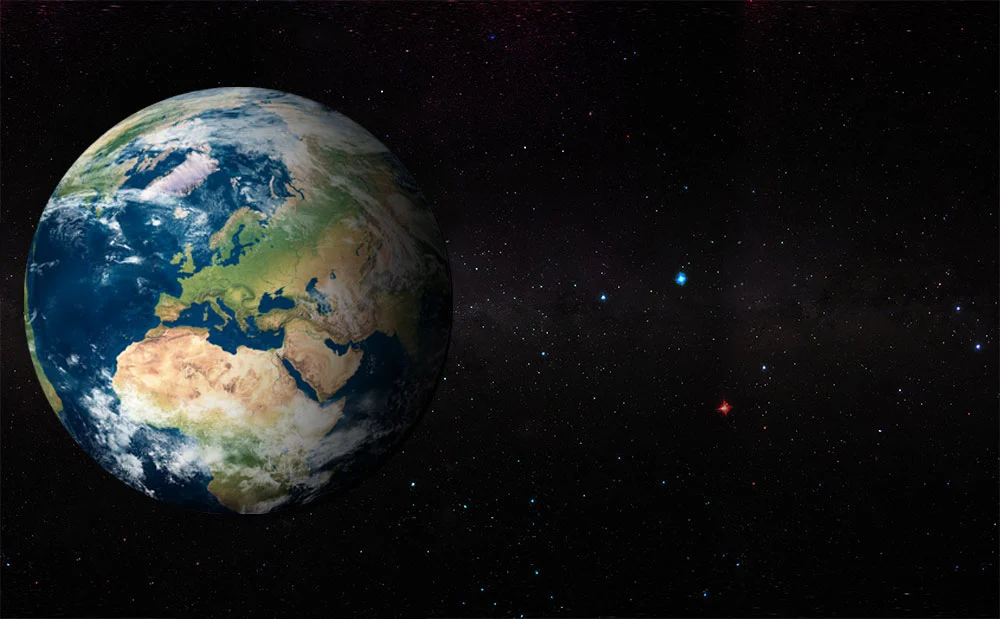
Our home world: an ocean-bearing rocky planet with a protective atmosphere, active geology, one Moon, and the only confirmed biosphere.
Ocean world
Confirmed life
One Moon
Briefing / verified snapshot
Earth file
Earth is the third planet from Sol, the largest inner rocky world, and the only confirmed life-bearing planet.
♁
Overview / baseline world
A living rocky planet
Earth is a rocky inner planet with liquid water on its surface, a nitrogen-oxygen atmosphere, active geology, and a global magnetic field. These systems do not operate separately: they interact to shape weather, climate, oceans, landscapes, and the conditions required by known life.
Because Earth is the only confirmed life-bearing world, it acts as the comparison point for Mars, icy moons, and exoplanets. When scientists look for habitability elsewhere, Earth provides the working example.
Primary source: NASA Earth facts.
System / water and air
Ocean world
Earth’s surface water and layered atmosphere make the planet behave as one connected environmental system.
Water, atmosphere, and climate
NASA identifies Earth as the only planet in the Solar System with stable liquid water on its surface. That matters because surface water is not just a scenic feature of the planet; it is part of the machinery that moves heat, shapes landscapes, supports ecosystems, and links the ocean to the air above it.
The atmosphere adds the second half of that system. NASA describes Earth’s atmosphere as layered, with the troposphere closest to the ground and the exosphere fading into space. Weather develops mainly in the lower atmosphere, while the wider atmospheric column helps regulate temperature, pressure, radiation, clouds, winds, and circulation.
Those two systems make Earth dynamic. Water absorbs and releases heat, the atmosphere transports moisture and energy, and together they create the conditions that the next section follows through the planet-wide water cycle.
- Liquid water supports habitability.
- Layered atmosphere.
- Water and air link weather, climate, and life.
Sources: NASA Earth facts; NASA atmosphere.
Cycle / moving water
Water cycle
Water continually moves between ocean, atmosphere, land, ice, groundwater, and living systems.
Circulation through the Earth system
The water cycle is the movement of water through Earth’s connected reservoirs. Solar energy helps evaporate water from oceans, lakes, soil, and vegetation. Water vapour then moves through the atmosphere, condenses into clouds, and returns to the surface as rain, snow, sleet, or other precipitation.
Once water reaches the surface, it does not follow one path. Some flows through rivers to the sea, some soaks into soil and groundwater, some is stored as snow or ice, and some returns to the air through evaporation or plant transpiration. That movement links the hydrosphere to the atmosphere, cryosphere, biosphere, and land surface.
This is why the water cycle is also a climate process. It moves heat, changes cloud cover, affects reflectivity through snow and ice, and helps determine where ecosystems and human societies can thrive.
- Evaporation, condensation, and precipitation.
- Links land, ocean, air, ice, and life.
- Solar energy drives movement.
Sources: NASA water cycle; NASA Earth system.
Energy / climate engine
Climate system
Earth’s climate is controlled by energy balance, atmospheric gases, ocean circulation, ice, land, and life.
Linked parts, long-term change
Earth’s climate depends on the balance between incoming sunlight, reflected sunlight, absorbed energy, and outgoing infrared radiation. NASA explains that greenhouse gases absorb and re-radiate infrared heat, which makes them central to how much energy remains in the lower atmosphere and surface system.
Climate is not the same thing as weather. Weather describes short-term local conditions, while climate describes patterns measured over long periods. Oceans store and transport heat, ice changes reflectivity, land surfaces alter absorption, and the atmosphere moves water and energy around the globe.
Because the system is connected, a change in one part can influence another. Ice cover affects reflectivity, oceans delay and redistribute heat, and atmospheric composition changes how efficiently Earth loses energy to space.
- Sunlight drives the system.
- Greenhouse gases affect heat loss.
- Long records separate climate from weather.
Sources: NASA climate; NASA radiation budget.
Life / connected systems
Biosphere links
Life is part of Earth’s operating system, interacting with air, water, land, ocean chemistry, and climate.
Biology as a planetary process
NASA studies the biosphere as part of the wider Earth system. Living systems depend on sunlight, water, temperature, nutrients, atmosphere, and land or ocean conditions, but they also change their surroundings through carbon cycling, land cover, soil formation, ocean biology, and atmospheric chemistry.
This means Earth cannot be understood as only geology, only ocean, only atmosphere, or only life. Plants, plankton, soils, forests, wetlands, and marine ecosystems all participate in wider material and energy cycles. Biology is carried by the planet, but it also helps shape the planet.
The biosphere card connects the physical Earth sections to the final habitability section. Once water, climate, geology, magnetic protection, and life are considered together, Earth becomes the benchmark for asking what “habitable” means elsewhere.
- Biodiversity spans genes to ecosystems.
- Life depends on and changes its setting.
- Biology links carbon, water, land, and air.
Sources: NASA biosphere; NASA et al.
Companion / lunar system
Luna
Earth’s Moon, Luna in Latin, is the planet’s only natural satellite and the most visible companion in the night sky.
Lunar orbit, tides, and phases
NASA gives the Moon’s average distance from Earth as about 239,000 miles, or 385,000 kilometres. It is Earth’s only natural satellite, and its gravity is central to the tidal behaviour seen in Earth’s oceans. The Sun also contributes to tides, but the Moon is the stronger tidal influence on Earth.
The Moon is tidally locked, so the same lunar hemisphere faces Earth as it orbits. Its phases are caused by changing viewing geometry: the Moon reflects sunlight, and from Earth we see different portions of the sunlit half during each lunar cycle.
Luna also acts as a visible clock in the sky. Its changing phase, position, and tidal influence connect the Earth system to orbital motion, leading into Earth’s wider relationship with the Sun.
- One natural satellite: Luna.
- Average distance: 239,000 miles / 385,000 km.
- Tides link Luna, Sol, and Earth’s oceans.
Sources: NASA Moon facts; NASA tides et al.
Shield / space weather
Magnetosphere
Earth’s magnetic field forms a protective region that changes shape as it meets solar wind from the Sun.
Protection, pressure, and aurora
NASA describes Earth’s magnetosphere as a magnetic-field system surrounding the planet. It helps shield Earth from harmful solar and cosmic particle radiation, but it is not a rigid shell. Its shape changes as the solar wind presses against it and as space weather conditions vary.
That interaction makes the magnetosphere both protective and dynamic. Solar storms can disturb near-Earth space, increase geomagnetic activity, and affect systems that operate above or through the atmosphere, including satellites, radio links, and navigation technologies.
NOAA explains aurora as a visible result of solar-wind interaction with Earth’s magnetic environment. Charged particles are guided toward polar regions, where their interaction with the upper atmosphere can produce glowing auroral displays.
- Shields against charged particles.
- Changes with space weather.
- Aurora marks geomagnetic activity.
Sources: NASA magnetosphere; NOAA et al.
Surface / active planet
Moving crust
Earth’s outer shell is divided into tectonic plates that move slowly over geological time.
Geology, hazards, and renewal
USGS describes a tectonic plate as a massive slab of solid rock, generally made of continental and oceanic lithosphere. These plates move slowly, and their boundaries are where much of Earth’s most visible geological activity is concentrated.
Plate motion helps explain mountain building, volcanoes, earthquakes, ocean trenches, and seafloor spreading. Some boundaries pull crust apart, some push crust together, and others slide sideways past one another, producing different surface features and hazards.
Earth’s active crust also connects deep planetary processes to the surface. Rock cycling, volcanic gases, erosion, ocean chemistry, and long-term carbon cycling all interact over geological time, helping shape the conditions available to air, water, and life.
- Plates divide the outer shell.
- Boundaries concentrate quakes and volcanoes.
- Geology links rock, ocean, and air.
Source: USGS plate tectonics.
Life / confirmed biosphere
Known life
Earth is the only world currently confirmed to host life, making it the reference case for habitability.
The habitability benchmark
Earth matters because it is the only confirmed example of a living planet. Its oceans, atmosphere, geology, magnetic environment, energy flow, and biological systems interact rather than operating as isolated features.
That makes Earth the reference case for astrobiology. Questions about Mars, Europa, Enceladus, Titan, and exoplanets often begin with Earth-based requirements: liquid water, useful chemistry, energy, environmental stability, protection from harmful radiation, and enough time for complex systems to develop.
For this project, Earth is the baseline world in the route. It gives meaning to the harsher environments around it: airless Mercury, greenhouse Venus, cold Mars, giant planets, icy moons, and distant outer worlds that may preserve only some parts of Earth’s habitability pattern.
- Only confirmed life-bearing world.
- Baseline for habitability studies.
- Air, water, rock, energy, and life link together.
Sources: NASA Earth facts; NASA astrobiology et al.
Evidence / source trail
Sources
Core Earth claims are linked to public science sources used across the dossier.
Earth facts
Planet overview, water, day, year, and habitability baseline.
Atmosphere
Atmospheric layers from troposphere to exosphere.
Climate
Energy balance, greenhouse gases, and climate evidence.
Luna facts
Moon distance, orbit, phases, and lunar context.
Magnetosphere
Earth’s magnetic shield and space-weather protection.
Aurora
Solar wind, geomagnetic activity, and auroral displays.
Plate tectonics
Earth’s moving plates and geological structure.
Biosphere
Life as part of Earth’s wider operating system.
© 2026 Phil Forster · Welcome to Sol · Horizontal Solar System briefing